WELCOME TO HELL - LAGOS, NIGERIA
PREAMBLE
“Welcome to Hell”
There were two omens. The dream, the night before we left. We were on the plane, taxiing down the runway, the engines started to scream, and I suddenly felt an enormous rush of fear and loathing for the journey I was about to take. “No!!” I yelled, “I don’t want to go!!!”
The second omen was conveyed via the inflight movie, which was “Groundhog Day”. This tells the story of a man who is condemned to live the same day over and over and over again, but of course I couldn’t know how prophetic this was until I’d been in Nigeria some time.
On arrival at Murtala Muhammed airport, Lagos, my first thought on leaving the aircraft was: “So that’s what foetid really means.” We were greeted by Jim’s two colleagues from the High Commission with the words “Welcome to Hell.”
Friday, 25 June 1993
We set off last Friday, after staying overnight with Uncle Bill and Jackie in Sevenoaks. Thursday night I dreamed I was on the plane, the engines were revving up for take-off, and I was seized by panic all of a sudden. “I don’t want to go!!” my mind screamed, “I want to stay in England!!” On waking I felt less apprehensive, my mind’s self-defence mechanism had taken over and we drove to Gatwick in the hired car as if we were going for a leisurely drive in the English countryside.
Two small shocks came in quick succession. On checking in our luggage we rapidly realized we had excess baggage. Quite a lot of it. The full extent of our folly totalled 100 kilos, 40 more than our allowance. The ground steward kindly allowed us 10 kilos each over the top, and cheerfully handed us a bill for £259 for the remaining 20 kilos. Jim glowered and marched off to pay the bill. While I waited for him I was approached by a tall dark stranger and a small darkskinned woman, who walked slowly and deliberately towards me, smiling strangely. On second glance I realized it was G……., last seen a year ago in Paris and supposed to be in Trinidad. After the stories I had heard from his estranged wife about their acrimonious split and his violence towards her, he was the last person I wanted to see at this crucial moment. He was flying back to Port of Spain with the diminutive dusky damsel. I wondered if he’d chosen her because bruises don’t show up so much on brown skin. By the time Jim returned from paying the bill, heaping abuse on me for overdoing it on the toiletries (of course his hi-fi speakers couldn’t possibly have contributed to the load) I was wishing I could start the day again. It was still only about 10.30.
Further frustration awaited. We were due to fly at 1.30 p.m. After returning the hired car and purchasing a camera in the duty-free shop, we went to the Club Lounge where we were informed that there was a technical fault on the plane and another one was being brought from Heathrow. We were assured that our latest departure time would be 6 p.m. It was now about 11.30. We calculated that a 6 p.m. take-off would bring us into Lagos at about 2.30 a.m. We helped ourselves to complimentary drinks and settled down in the lounge for a long wait. It was not long before we were told that we would be taking off at about 2.30 p.m., only an hour late. My spirits lifted, and even Jim seemed to be getting over the shock of the excess baggage charge. The lounge was occupied mostly by Brits and a few very smart Nigerians with gold watches and briefcases.
At 2.30 were were installed in our Club Class seats on our 747, flight BA 075, opening our goody bags and playing with the video screens set into the back of the seat in front. A call for a Nigerian passenger was made a couple of times, then the pilot announced that the passenger had not boarded after checking in luggage, and they would have to search for the offending suitcase and remove it from the plane. At 3.30 we finally taxied down the runway. I waited for the screaming habdabs. They didn’t come. We took off.
The flight was smooth and uneventful. Passengers were anaesthetized by films, food, drinks, a short sleep, more food, and so on for six hours. I watched a film called Groundhog Day, starring Bill Murray as a man who is condemned to live the same day over and over again. It was a year before I realized what an omen this was. Jim finally came out of his sulk somewhere over the middle of the Sahara. As we descended towards Lagos, the lights of the city twinkled and we emerged from the black rainclouds onto the soil of Africa. I girded my loins for Lagos airport, reputedly one of the most unpleasant in the world.
The 747 had vomited its load of sweaty humanity into the terminal with a depressed sigh as the engines died. The air was syrupy and dank at 8 p.m. Uniforms of all colours abounded, I assumed military, but in fact probably customs and immigration officials, not that there was much difference under Babangida’s junta. Jim’s colleagues greeted us at the finger with the words “Welcome to Hell”, and introduced us to Joseph, a smart young Nigerian in an immaculate white short-sleeved shirt and tie, carrying a two-way radio. He asked for our passports, and promptly set off towards arrivals, where he confidently strode past the queue to the immigration desk. He seemed to know the officials quite well. Next thing we knew a fat uniform was calling over: “Where is your diplomat? Come! Come!” and we were in Nigeria. It must have taken no more than two minutes. Now that was a VIP channel.
The uniformed and heavily-armed soldiers stood aside as we were waved through in no time. The wait for the luggage was longer, but all pieces appeared intact, and before we knew it we were piled into a waiting Landrover and were hurtling down a motorway into the city. The traffic was moving quickly and the uniformed High Commission driver wove expertly in and out of the cars, giving an authoritative honk on the horn every so often. Most of the other cars on the road were trucks, vans or ordinary saloon cars, all in extremely shabby condition.
Apart from the heat and humidity, which was assuaged somewhat by the airconditioning in the Landrover, nothing seemed too terribly different from Europe. In retrospect, I speak as if I rode around in Landrovers all the time before I went to Africa. In fact I’d never been in one before. I don’t know what I’d been expecting - tribal dancing at the baggage reclaim area? Giraffes in the car park? The driver sped down a freeway as Jim and the lads worked their way through a coolbox full of Heineken. I peered through the windows looking for Africa, but saw only blackness. Taking the same road again in daylight I understood why. It was a 3-mile long road bridge cutting right through the Lagoon, with only water on either side.
I awoke the next morning listening for the drums and giraffes. It was mighty quiet out there. I pulled back the curtains and looked through the iron bars welded over the window. Beyond the bars were high iron railings topped with razor wire. Beyond the railings were palm trees, more low buildings with barred windows and people. Black people. Exclusively black people. I had been expecting something like South Africa, where “white” districts were peopled by whites. There was not one white face down there. The Nigerians - not hordes of them, it was still early - went about their business at a calm and leisurely pace, as if they owned the place. For the first time in my life I started to be aware of being a foreigner.
Beyond the railings of the compound was a poorly tarmacked road with muddy verges in the guise of pavements. A number of tall palm trees and other lush foliage in various shades of green lined the street and neighbouring gardens. Nigerians were going about their business, women and children carrying huge loads on their heads with apparent ease, others chatting with the stallholders on the corner, everyone dressed in costumes ranging from sober European business attire to brightly-coloured costumes of every imaginable cut and style.
Across the street was the Nigerian Air Force Officers’ Mess, a low building inside a compound with gardens and a car park at the front and a playing field at the back. A street sign outside the railings informed me I was on Kofo Abayomi Street, on the corner of Apese Street. The sun was strong already, and opening the window I felt the air outside hot and sticky. I closed the window again. I realized my vision of taking breakfast on the balcony would not become much of a reality. In any case, the balcony was barred with heavy steel gates secured by two heavy padlocks, and we hadn’t yet located the keys. We were effectively prisoners in our own home.
However, we plucked up the courage to explore our compound. There was not much of a garden, just a large square spiky lawn at the back with a lovely old tree in the middle, a brick barbecue and some garages. We introduced ourselves to the guards, who both appeared to be called John. The vegetation inside the compound was lush, and there were lizards galore: small brown ones darting out of our path before we even saw them, and big multi-coloured ones basking in the sun, their black body, red head and long red and green tail bobbing up and down as they appeared to do push-ups. Crimson dragonflies darted about like miniature helicopters.
Exploring the apartment kept us busy all day, which was just as well, since we were too scared to go beyond the boundaries even in daylight. The tales of violence and hostility were fresh in our minds, and even the Rough Guide to West Africa had failed to put our minds at ease. So we explored our new cage. Not only were there bars on the windows, but no less than three armoured doors, front, back and separating the sleeping area from the day area - this one was called the “keep” door. Alarm panels were strategically placed throughout the flat, and a couple of two-way radios stood in chargers. From the back window we could see that the razor wire went all the way round the property, or “compound” as I must now call it. We could find no keys to unlock the barred gates to the balcony. The kitchen was equipped with a fridge and freezer, each the size of a wardrobe. A mysterious white enamel drum revealed itself to be the water filter. I had read the post report, but couldn’t remember if you were supposed to boil, then filter, or the other way round. The water from the tap was surprisingly clear, but we weren’t taking any chances, and made our morning tea with filtered water.
Thus our first day in Nigeria was spent like caged animals. We had no transport, no idea where anything was, and were too scared to brave the streets on foot. None of the neighbours called in to introduce themselves. The phone didn’t ring. By afternoon we had plucked up enough courage to explore the compound. At the rear of the building was a square patch of springy grass with a magnificent tree in the middle. Beyond that was a row of lock-up garages. And that was it. We strolled around to the front of the compound where the guards were dozing and chatting in rusty garden chairs. They sprang to their feet when they saw us and stood to attention. One saluted. We smiled and strolled across to introduce ourselves. Christ, how do we do this? Should we play it old-colonial and businesslike, or PC and pally? We went for a combination of the two, withholding handshakes and first names (ours that is) but smiling a lot. The guards appeared to be both called John. They were both young and called us “Sah” and “Madame”. We drifted back to our cage.
That evening we were invited to dinner at Andrew’s flat. Ian called for us in a gleaming Japanese four-wheel drive with a gleaming black driver, both of which were on loan from the boss who was on leave in the UK.
Ian called for us in the evening with Jim Gardiner’s car, a gleaming bronze Mitsubishi Montero driven by gleaming black Seraphin, Jim’s Beninois driver. Darkness fell quickly at 7 p.m., so my view of Lagos from the car was not much more forthcoming than the previous evening. Poor street lighting, a bridge, a bumpy road, more gate guards. We returned to Ikoyi island where it appeared the entire High Commission staff, with the exception of the six families in our compound, lived. Jim's colleague Andrew was having a dinner party and we went through the usual niceties with the other guests. Beer appeared to be the aperitif of choice. Nibbles were brought by Andrew’s discreet Beninois steward, Noel, wearing white pyjamas and bare feet, who glided silently in and out replenishing glasses and emptying ashtrays. At dinner I found myself next to a bloke from Tooting. The girls from the High Commission were like Foreign Office girls everywhere – impassive, bored, apparently oblivious to their whereabouts and with an astounding ability to completely ignore people, particularly (though not always) the “locals”. Perhaps it is some kind of defence mechanism for dealing with the weird surroundings they find themselves in, but I think it will be some time before I mentally adjust to being one of “us” as opposed to one of “them”. The conversation was relaxed to the point of idle banter. Everyone appeared supremely bored, and no-one was particularly interested in the new arrivals. We got quite sloshed and were glad someone else was driving us home. I was worried about Seraphin waiting outside with no idea what time he would be required to drive us home. I was assured it was not a problem for him. In the end we left about 2.00 a.m. Jim fell asleep before I could make him take his Paludrine.
On Sunday we finally located the balcony keys and could at least look out without bars onto the street. Back in Europe I had envisaged leisurely breakfasts of mango juice and fresh pineapple taken in the cool morning air on the vast terrace. The balcony was small, and the air was so hot and humid that it was uncomfortable. Apart from that, it overlooked the street where passers-by could see us.
Sunday morning dawned bright and hot, and still no sign of the famous rain. The lush vegetation indicates, however, that there is no shortage of precipitation here. Nigerians dressed in their Sunday best strolled past on their way to church. I used the phone for the first time to call Ian, and decline his invitation to the beach, and was surprised to get through first time. We had heard that someone called Flo was calling round to take us shopping. She turned out to be called Sandra, not Flo - FLO, or Family Liaison Officer, was her job. She wore a flowery frock and was rather posh. We set orf in her Range Rover which she drove herself. At last I could see Lagos in daylight.
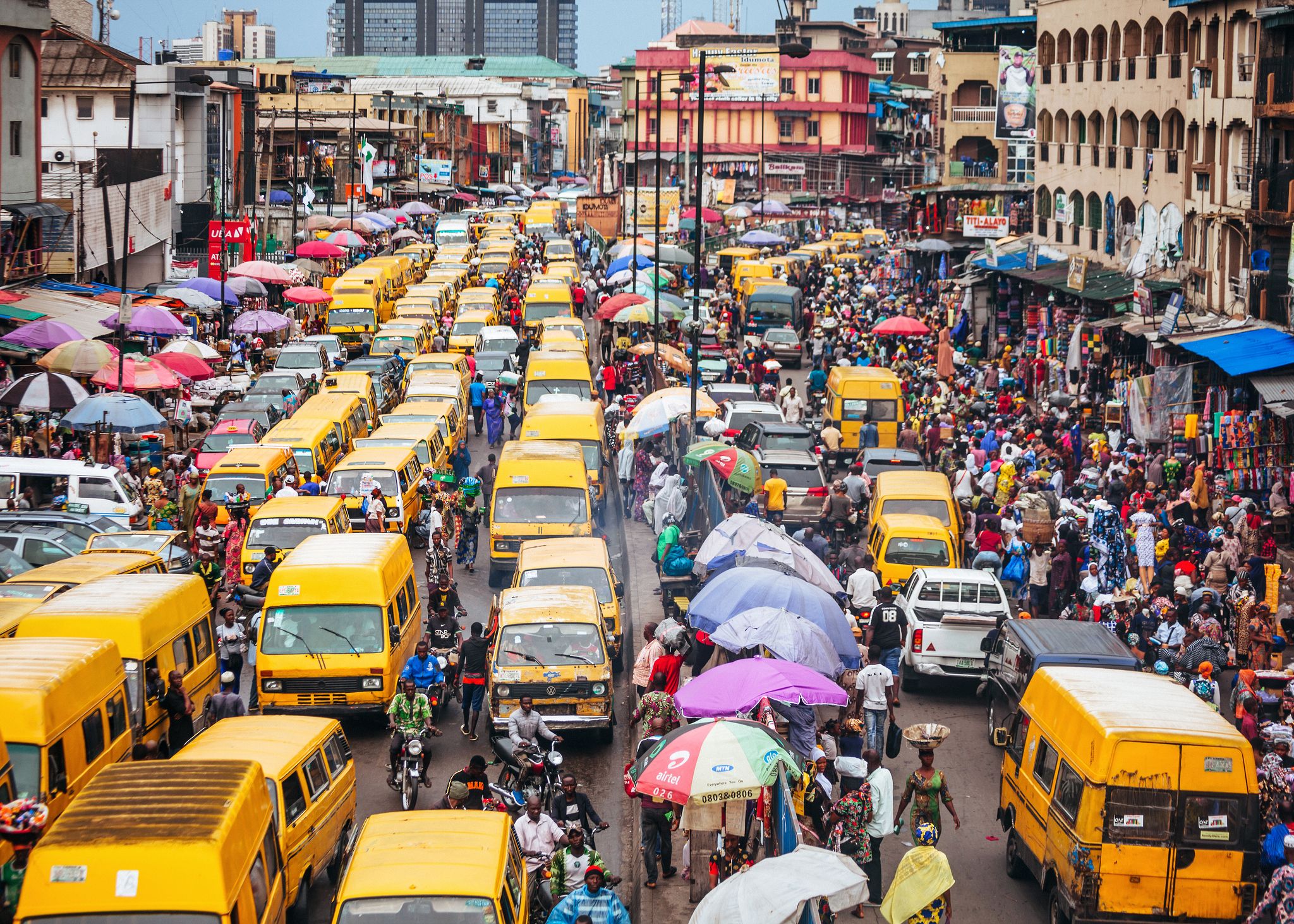
It was an eye-opener. Filth, poverty, deprivation, it was all there as described, but it was also a vital city, buzzing with life as well as flies. We passed a Catholic church where the congregation was spilling out onto the pavement, in stark contrast to the abandoned and deconsecrated churches we see more and more in England. We went back to Ikoyi (everything and anything you need seems to be on Ikoyi, or anywhere except Victoria Island) and did some shopping in funny little supermarkets which had been described to me in Paris by an old Lagos hand as something akin to Wavy Line stores, and it was a pretty accurate description.
Stalls were set up on the side of every road. Nigerians were walking about dressed in all kinds of attire, from ordinary western clothes to brightly coloured local costume. There were even some wearing nothing at all, who appeared to be giving each other showers from a plastic bucket on a piece of waste land. We drove past a church where the congregation was so huge it spilled out the doors. Much white lace, ribbons and hats were in evidence.
We pulled up at a store called Jay Jay’s and Flo gave me a tour. It was about the size of a corner-shop grocery, but the shelves were well stocked with all manner of imported goods. I couldn’t take it all in on the first visit but noted with dismay that fresh milk was nowhere to be seen. I had a hearty dislike of UHT, but it looked as if that and Marvel was all there was. The shoppers were mostly white but a few well dressed Nigerians were stocking up on such favourites as Ribena and Horlicks. The local Arab grocer in Paris looked like Harrod’s in comparison. Not that it was the emptiest store I had ever seen (that was in Algeria) but the goods on offer were a poor selection, of poor quality and unattractively presented. I was warned that stock varies from day to day and that I should snap up things as I saw them, since I might not see them again for months (hence the huge freezer).
In the afternoon we were determined to escape from stalag Windermere, so hi-jacked the downstairs neighbours into giving us a lift to the Club. They were not overly friendly, or overly our type at all, but we got our lift. More gates, more guards. And - oh joy! - a swimming pool. We sat, in the manner of the British, well away from everyone else. Not that the place was crowded. The open-air bar under a thatched roof looked inviting, and I tried a local non-alcoholic drink called a Chapman, a mixture of orange squash, lemon squash, Ribena (aha!) and lemonade or soda, with a splash of Angostura bitters. It was starting to feel glamorous.
On the Monday Jim was to start work and I was on my own. I had the use of the boss’s car and driver, called Seraphin, but even so I was nervous about braving a West African city for the first time. When Seraphin called I was flustered, not wanting to keep him waiting. Some people might find having domestic staff the last word in luxury, but it certainly takes a serious change in attitude. Seraphin sensed my nervousness and it seemed to make him nervous too.


Comments
Post a Comment