ONE DAY I'M GOING TO LIVE HERE
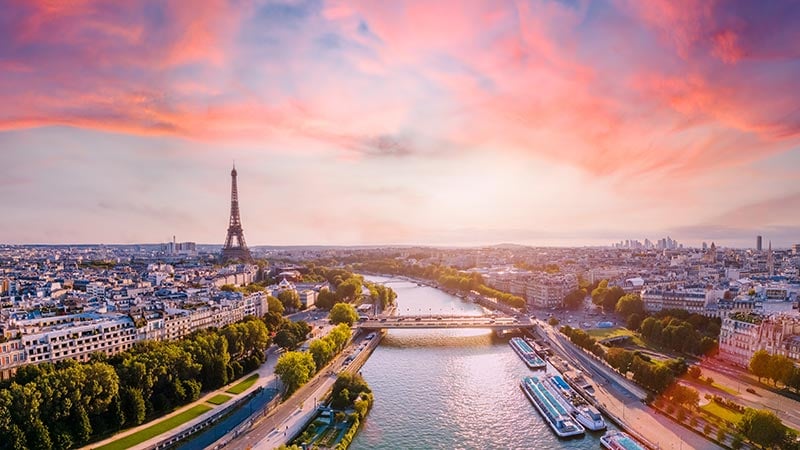
In summer 1970, aged 15, I first set foot on foreign soil. I went, chaperoned by aunty Lily, for a long weekend to Paris. As was the fashion in those days, encouraged by language teachers, I had a French pen friend. Her name was Geneviève Gabens and she lived in Vincennes near Paris. We swapped things that 15-year-olds do – pictures of pop stars, teen mags, etc. Hence at 15, pictures of sultry Julien Clerc and Sacha Distel adorned my bedroom wall alongside David Cassidy and Donny Osmond. Aunty Lily organised it all. We flew from Ashford on a shaky old turbo prop plane, the first time I had ever flown. Having suffered from travel sickness since a child, flying was no better, and by the time we touched down at Beauvais, I was green and throwing up. I was hardly aware we were in France until we arrived in the airport shuttle bus at Place de la République. I was about to start the weekend that changed my life. Geneviève and her father were waiting for us at République. Denis was a funny rotund little man with a very French moustache. He piled us into his Saab and set off into the maelstrom that is Paris traffic. We stayed at their house, a bungalow on the campus of the University of Vincennes campus, where her father was manager of the cafeteria. I was not aware that this was an experimental campus, open to all, which had been set up in the aftermath of May '68 with taxpayers' money, on the site of a long-abandoned military base in the Vincennes forest. If you had told the 15-year-old me that Michel Foucault was sitting on the other side of the canteen, it would have meant nothing (although he probably wasn't as it was the academic holidays). My young head was too full of stars in this heavenly place that was Paris. To thank the taxpayer, the students rioted again in June 1969 and trashed the place. It was known to be a hotbed of lefty factions - who all hated each other more than they hated the government. Sub-factions mushroomed: Marxist-Leninists, Maoists, Trotskyists, Stalinists, People's Front of Judea ... When I first stayed there it was covered in graffiti, the auditorium had seats missing, and it looked like the aftermath of a warzone. Geneviève's dad explained that the authorities had decided the students would have to live with what they had done and there were no plans to clean up the mess. The campus continued to function - barely - throughout the 1970s, although increasingly badly managed and with a rapidly deteriorating infrastructure. It was dirty, everything was broken, and a degree from there was worthless. Pretty much like soviet communism, in fact. In 1980 the university moved to St Denis and Jacques Chirac ordered the complete destruction of the old campus. There are no traces today of what was once the centre of the Parisian loonie left. Geneviève’s mother Raymonde was waiting to meet us at home. She was a bird-like little woman (they were all little) with a beaky nose and rimless specs, and she made us extremely welcome. Aunty Lily was wonderful, despite having not a word of French. I acted as interpreter, and was amazed to find they could understand my school French. Raymonde gave us a great dinner, although I can't remember what it was, but I know it was all very different from what I had at home. I fell head over heels in love with Paris that weekend. Apparently I said to my aunt "One day I'm going to live here". (And so, dear reader, nine years later, it came to pass). In 1971 I returned to Vincennes on my own for three weeks. I took the train to Dover, where I transferred to the cross-channel ferry, and then back onto another train to Paris. There was passport and customs controls on both sides of the Channel, and you were only allowed to take £40 in cash out of the country, any more had to be in travellers' cheques. In 1972 I was offered the chance to bid for a scholarship from the now defunct GLC to spend 10 weeks in France. The deal was, I had to attend a course, then spend six weeks staying with at least two different families - and preferably not in the capital, as it was thought the chances of mixing with other Brits would be lesser in the provinces. After the interview in County Hall, where I was impressed by the high ceilinged corridors of this temple of power, I was told I was one of the lucky recipients. Nan took me to the French cultural institute in Kensington where a nice man arranged for me to be the guest of friends of his in Grenoble, after which I would spend some time with the family of our school “Assistante”, Geneviève Kessedjian, in Valence (was everyone in France called Geneviève?). In 1973, studying German for A-level, I won another scholarship and returned to County Hall. It was the same deal as before - a 3-week language course in Salzburg, followed by stays with two different families. I had a German penpal in Munich, Nicky someone or other, and had kept in touch with one of the students from Boulogne, Wolfram Boecker, who invited me to come and stay with his family in Cologne. The trip to Austria and Germany was a real summer of love. In Salzburg I was billeted in a kind of hostel and teamed up with two other girls, one of whom was from Bournemouth, the other one I can't remember for the life of me. We went to classes, and went out on jaunts together. Salzburg in the summer is full of jolly drinking gardens and we spent many a happy hour in the one downtown. The Salzburg festival was on, a unique opportunity to soak up some culture, but despite being given free tickets to see Curd Jurgens in Jedermann (the German equivalent of Sir Laurence Olivier in Hamlet) me and my cultivated mates preferred to get drunk in the Biergarten. One day I saw the great diva Leontyne Pryce strolling across a bridge in full opera cape and cane, as befits an opera star, with her posse strolling alongside looking like nothing less than particularly dapper Harlem hoodlums. We had another watering hole halfway up the cliff face that we had to climb to reach our hostel, where we befriended the waiter Robert Walker from Oklahoma, one of these superannuated hippies working his way around the world. One day, out with the girls, we happened upon three travellers doing some kind of mad turn in the street for money. They invited us into their camper van for a drink, and we ended up spending an entire weekend with them. They were a Canadian called John, an Australian called Dorian and a New Zealander called Doug. They were sassy, quick-witted and fun, they took us for picnics in the rain, we sang songs, we had a great time with them. By the time they moved on, two of us were in love. After Salzburg I went to stay with my German penpal Nicky. This was an eye opener. She lived in a council flat in the suburbs of Munich with her parents and her brother Kurt. It didn't take long to work out that Nicky was a bit of a slapper. She dragged me downtown and inveigled me into a scam involving picking up some middle ages blokes so they would buy us drinks. She was two years younger than me, only 15. I found her quite scary, and ended up spending more time with her 17 year old brother Kurt and his pals. I was not interested in picking up boys as I was (a) in love with Doug the Kiwi and (b) still declaring undying love to Jon, aka Silverboots. He was sending me letters almost daily, peppered with drawings, some of them a bit worrying. They involved a lot of pictures of syringes and stylised graffiti of the words COCAINE and MORPHINE. I was however sure he was not a druggie. I finished up my tour of German speaking countries with a week in Cologne at Wolfram's place. We hung out a lot with his mates, one of whom I developed a bit of a crush on. Wolfram's father was a judge and they lived in a nice part of Cologne called Koenigsforst, in a big old detached house. The room I slept in was right at the top of the house, with a big tree outside the window. One night we went to see “The Exorcist” at the cinema. It affected me profoundly, and I don't think I got much sleep that night with the branches brushing against the window. Another time we went to a Lou Reed concert. Lou was over an hour late. I didn't have a crush on Wolfram, somehow it was never that kind of a relationship. Wolfram wasn't the kind to hit on me just for sex, he was sensible enough to wait until he met somebody he really fancied. (In 1979 on the return leg of my Interrail tour of Europe with Pud I stayed at his flat in Cologne where he lived with his girlfriend Renata.) Having passed my A-levels in French and German, and taken a year out, I started university in Southampton in 1974. I had the option of doing my degree in four years with a year abroad, or doing it in three with two long vacations abroad. As I had started a year late, I decided to do the concertina version, so in the summer of 1975 I went on a month’s German language course at the University of Vienna. It was a pretty boring month – Vienna in July is a ghost town. I roomed with a Swedish girl called Weronika, and the high point of the lesson was firing questions at the student from the PRC who was our star pupil and trying to wind him up. “Es gibt kein Verbrechen in China!” ("there is no crime in China!") he would insist. One of our jaunts was a boat trip up the Danube, through Slovakia to the Hungarian border. As soon as we were in Slovak waters a police motor launch appeared and shadowed us right up to the border and back, where it disappeared as mysteriously as it had appeared. Being Brit teenagers we were getting drunk on beer and making rude gestures to the police. For the summer of 1976 I swung a place on an International Relations course at Geneva University. I have a vague feeling I’d heard Mr Mazola, the smooth Algerian from Southampton Uni on whom I had a raging crush, mention he was spending the summer in Geneva and I’m sure that had some influence on my decision. I cannot remember where I stayed for the four weeks of the course – it must have been some university accommodation. I went to classes and took copious notes about the structure of the UN, the ILO, the WHO, and other international organisations. In the evenings I went Looking for Mr Goodbar. At the university canteen I met a bunch of South Americans (all men) who were great fun. One in particular, a Mexican called Arturo Espinosa, was visiting from Paris, and was a singer and guitarist. He was staying with his friend Fernando Sandoval who worked at the UN. The others were Fiula from Chile and Alfredo from Argentina, Carlitos from Colombia, Caxi from Venezuela, Rodolfo another Peruvian, and Cesar Acevedo Lopez, a black guy from Peru. They were an exuberant, funny bunch of guys and let me hang around with them. I picked up passable Spanish just from hanging around. I was known as “La Loca”. The crazy woman. I thought it was a term of endearment. We used to hang around cafes where their Peruvian mate Raul Torres played with his group “La Flute des Andes” – precursors of the ubiquitous pan-pipe players you find today in every High Street from Northampton to Novgorod. We were the “claque” whose job was to clap enthusiastically and flourish money to get the crowd going. Raul would give us the money back later. Then he would whisper where they were playing next and we’d all pile into someone’s car and shoot off to be waiting for them when they turned up. Somehow I ended up being Cesar’s “mujer”. Or one of them. That was one of the wildest summers of my life. One day I was in the Movenpick restaurant (which did a spectacular 7-scoop ice cream sundae) when I spotted a familiar face, or rather hairstyle. It was Mr Mazola, from Southampton. He was friendly and we arranged to meet for a drink at the Britannia. When he turned up he had a pretty blonde girl in tow. He introduced me to her as his Swiss wife, Monika. I didn’t make any attempt to keep in touch. When the course ended I was having such a good time I wanted to stay in Geneva. Fernando knew an English girl who worked in a hotel, and introduced me. Diane got me into the Hotel Grand Pré, behind the railway station, where I worked as a waitress. I got a room in the hotel, and was paid in cash, no questions asked, quite a considerable sum of money. I can’t remember exactly how much, but I know I had about £100 saved by the time I returned to England after two months. It was implicit that it was not entirely legal. Diane took me to the Britannia Pub opposite the station, and introduced me to some of her friends. Darts was big in Geneva that summer, and the two reigning champions were Jimmy the long-haired Malaysian and Khaled. Khaled was a skinny, fast-talking, sharp-dressing Egyptian with a low tolerance for alcohol and a regrettable penchant for getting into fights. I took up with him, despite the fact that I was already having a fling with Cesar. When they eventually found out about each other, they both chucked me, Cesar saying I was a slut for sleeping with an “Aravo”, Khaled saying the same for sleeping with a black guy. They both took me back about a week later. I kept them both going for two months. In the hotel I was working with a motley crew of various nationalities. Most of them were Catalans presided over by a fast and quick-witted gay waiter called Daniel who was funny as hell. A couple of the Catalan chambermaids, one called Maroja, worked with a laconic American porter called Steve Burger. Mid-morning as they worked the corridors, you could hear Maroja, a room ahead of Steve, shouting “Andale, andale, escargot americano!” and Steve’s muffled drawl from inside a room: “OK, OK, Maroja, j'arrive”. Steve and I became good buddies and whenever we had our day off together would take a bus up to one of the waterside restaurants for lunch on Lac Léman. It was an entirely platonic relationship. Steve half-heartedly invited me one day to go back to his place, but I felt he was just being polite. Such was the spirit of the time. I politely declined. He was altogether too white for me at that point in my life. There was a French woman who came into work from over the border. She had a Swiss boyfriend but because she didn’t pay tax in Switzerland, she was not allowed to spend the night on the Swiss side of the border. One day she was late for work, having been hauled out of her boyfriend’s bed at 4 a.m. by the “Controle de l’Habitant” or Swiss immigration police who had watched her go into his flat and waited outside all night to nab her. We were of course all working illegally. But the Controle de l’Habitant were so easily spotted, whenever they walked into the Britannia pub, always in pairs and dressed in long leather coats, most of the clients would suddenly have to go to the toilet and make a quick getaway by the rear door. I would come back to the hotel after my nights out with Khaled or the South Americans at 3 or 4 a.m. and sleep for a couple of hours before opening up the kitchen at 6.00. We served breakfast to mostly tour groups. The Americans were the worst – we offered a set continental breakfast, with optional extras such as omelettes, boiled eggs, etc. When an American group came in, we would look at our watches and count the seconds until the first shout of “Miss!” went up. It was never more than 30 seconds. “Miss! Mushroom omelette, crisp on the outside, runny on the inside!” “Miss! Two boiled eggs – exactly two and a quarter minutes, no more!” “Miss! Bacon, eggs, tomaytoes, mushrooms, sausages and all the trimmings!” “Miss! Pancakes with maple syrup on the side!” Our favourites were the Mexicans who never asked for anything extra and were super polite. They didn’t tip like the Americans but we preferred to have less hassle and do without the tips – we were on good enough money anyway. Certain evenings I manned the bar, in the breakfast room. There were never more than a couple of customers. At the end of the summer I kissed my two boyfriends goodbye and returned to England and my final year. Steve mumbled something about heading for Paris.


Comments
Post a Comment